Typing in Feelings: How Asian Visual Language Quietly Replaced the English Sentence
Somewhere between 2012 and right now, something quietly broke inside the American sentence. Not in a bad way — more like how a bone heals stronger after a fracture. Words didn't disappear. They just stopped being the whole story.
Open any group chat today and you'll find a collage: a crying-laughing face stacked on top of a LINE sticker of a sleepy bear, followed by three words of actual English, then a string of symbols that looks like someone's keyboard had a sneezing fit. That last part? That's a kaomoji. And if you've been using one without knowing what it's called, you're already living proof of the thesis.
Asian digital communication — specifically the visual and symbolic traditions that grew out of Japanese and Korean internet culture — didn't just influence how Americans type online. It fundamentally rewired what online expression even means.
Before the Emoji, There Was the Emoticon — and Before That, There Was Japan
Western tech history books tend to credit Scott Fahlman, a Carnegie Mellon professor, with the first emoticon back in 1982. He typed :-) into a message board and everyone acted like he'd invented fire. And sure, credit where it's due. But while Americans were rotating their heads to read sideways smiley faces, Japanese users were building entire emotional landscapes without tilting anything.
Kaomoji — literally "face characters" — emerged from Japanese bulletin board systems in the late 1980s. They read straight across: (´•ω•`) and (╥╥) and the iconic ¯_(ツ)/¯, which has since escaped into the wild and now lives rent-free on every American's keyboard. Unlike their Western cousins, kaomoji didn't require you to tilt your head. They were designed around non-Latin character sets, which gave Japanese users access to a much wider palette of shapes, curves, and symbols to work with.
That wasn't an accident of creativity. It was a direct consequence of the writing system itself. When your language already operates through a combination of logographic and syllabic characters — kanji, hiragana, katakana — you develop a fundamentally different relationship with the visual weight of text. Characters carry emotional tone. Spacing carries rhythm. The sentence is already a kind of design object.
Western languages, built on a 26-letter alphabet, didn't offer the same visual flexibility. So when Japanese internet users started pushing the expressive limits of their character sets, they were essentially building a new language from materials the West simply didn't have access to.
Sticker Culture and the Death of the One-Word Reply
Fast forward to the smartphone era, and the clearest export of Asian visual communication culture is the sticker — specifically the kind popularized by LINE, the Japanese messaging platform that became dominant across East and Southeast Asia through the 2010s.
LINE stickers aren't emoji. They're closer to micro-illustrations: full scenes, character expressions, layered emotions rendered in a single image. A sticker doesn't just say "I'm happy." It says "I'm the specific kind of happy where I'm spinning in a field while a cartoon bear watches approvingly." The granularity of expression is entirely different.
Kakao, the South Korean platform behind KakaoTalk, pushed the format even further. Their sticker ecosystem gave rise to characters like Ryan the lion and Apeach, who became cultural icons before most Americans had ever heard of the app. Those characters didn't stay in Korea. They migrated — through K-pop fandom communities, through social media, through the general osmosis of internet culture — and landed in American group chats, Discord servers, and Instagram DMs.
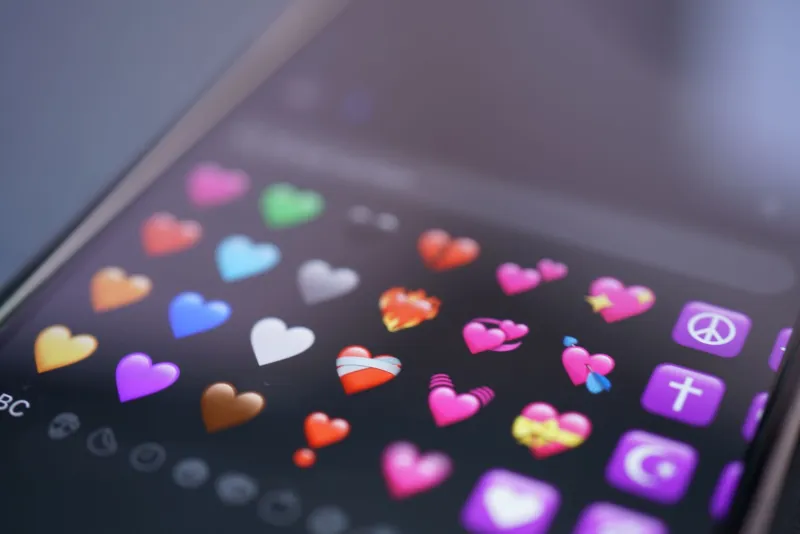
Apple and Google watched all of this happening and responded by building out their own sticker ecosystems, expanding emoji libraries at a pace that would've seemed absurd in 2010. The pressure to keep up with Asian messaging platforms was real and documented. The emoji keyboard you use every day is, in no small part, a product of competition with LINE and KakaoTalk.
Gen Z Doesn't Write Sentences Anymore — They Curate Reactions
Here's where things get genuinely interesting from a cultural standpoint. The generation that grew up with all of this infrastructure in place doesn't think about visual language as a supplement to text. For a huge portion of Gen Z, it is the text.
Research on digital communication among younger users consistently shows a preference for image-based or symbol-based expression over written sentences, particularly in casual or emotional contexts. You don't type out "I'm exhausted and emotionally unavailable right now" — you send the specific emoji combination that your friend group has collectively decided means exactly that. The meaning is encoded. The translation is shared.
This is remarkably close to how logographic writing systems work. In kanji, a single character can carry a concept that takes multiple English words to express. The compression is the point. Gen Z didn't study linguistics to arrive at this communication style — they just absorbed it from the platforms and cultural products they were already consuming.
Anime fandoms, K-pop communities, and gaming culture all acted as accelerants. These are spaces where Asian visual communication norms were already operating at full intensity, and where American participants had to either adapt or feel perpetually behind. Most adapted. And then they carried those habits into their everyday digital lives.
The Platform Response: Building for a Visual Brain
Social platforms didn't miss this shift. They engineered for it.
TikTok's comment section is its own ecosystem of visual shorthand — a mix of emoji strings, repeated characters for emphasis, and reaction patterns that owe more to Asian internet culture than to anything that came out of Silicon Valley. Twitter (now X) users figured out years ago that a well-placed kaomoji could carry more weight than a full paragraph. Discord servers run on custom emoji that function like inside jokes encoded as images.
The infrastructure of digital expression has been rebuilt around the assumption that users want to communicate visually first, verbally second. That's not a Western default. That's an imported one — and the import came primarily from the east.
Why This Matters Beyond the Chat Window
It's tempting to treat this as a fun trivia point. "Did you know emoji culture came from Japan?" Sure, cool, moving on. But the implications run deeper than cocktail party conversation.
The way a culture communicates shapes what it can express — and what it decides is worth expressing. American digital communication has been absorbing a visual vocabulary built on fundamentally different assumptions about language, meaning, and emotional nuance. That's not a neutral exchange. It changes things.
The irony is that most Americans participating in this shift have no idea it's happening. They're not consciously adopting Asian communication styles. They're just texting. But the tools they're texting with, the platforms they're texting on, and the visual grammar they've internalized to do it — all of it traces back to design decisions made in Tokyo and Seoul years before American tech companies caught up.
The English sentence isn't going anywhere. But it's sharing the conversation with something older, more visual, and considerably more expressive. And honestly? The chat's better for it.