Scroll Down to a New Story: How Webtoons Broke the Comic Book Mold for a Mobile Generation
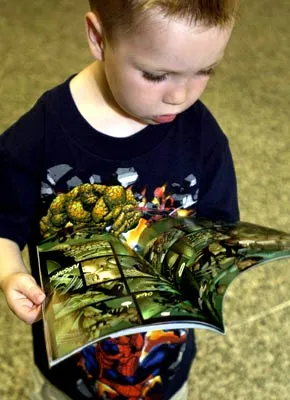
Photo: Defense Dept. photo by U.S. Air Force Tech. Sgt. Cherie A. Thurlby, Public domain, via Wikimedia Commons
There's a moment every new webtoon reader describes the same way. You open an episode, start scrolling, and somewhere around the third panel you forget you're reading a comic at all. The story just... moves. That feeling — that frictionless pull through a narrative — didn't happen by accident. It was engineered in South Korea over two decades ago, and right now it's quietly rewriting the rules of how Americans consume visual fiction.
Webtoons are vertical-scrolling digital comics built specifically for smartphone screens. No page turns. No left-to-right panel grids. Just a continuous ribbon of art and dialogue that flows downward like a social media feed. The format launched in the early 2000s on Korean platforms like Naver and Daum, where creators could publish directly to audiences without going through a publisher. Sound familiar? It should — webtoons basically invented creator-direct digital publishing before YouTube made it cool.
Why the Format Hits Different on a Phone
Here's the thing about traditional Western comics: they were designed for print. The grid layout, the left-to-right reading order, the page as a unit of storytelling — all of that made perfect sense when you were holding a physical issue of Spider-Man in your hands. On a phone screen in portrait mode, though? It's a mess. You're zooming in, rotating, losing your place. The experience fights the device.
Webtoons don't fight anything. The vertical scroll is already how Gen Z interacts with literally every other piece of content on their phone — Instagram, TikTok, Reddit, Twitter. When you read a webtoon, your thumb is doing the exact same motion it does scrolling through your For You Page. The cognitive load drops to almost zero, which means your brain has more bandwidth to actually absorb the story.
Creators figured out fast that this format unlocks new storytelling tricks. Pacing becomes a function of scroll speed. A dramatic reveal can be timed by how much blank space a creator drops before the next panel. Horror webtoons — and there are a lot of excellent horror webtoons — use the slow scroll to build dread in a way that a static page flip never could. You know something is coming. You keep scrolling anyway. That's a specific kind of tension that the format almost creates on its own.
From Naver to Netflix: The Platform Pipeline
Webtoon Entertainment (the global arm of Naver's LINE Webtoon) now claims over 85 million monthly active users worldwide, with a significant chunk of that audience based in the US. Tapas, another major platform, has carved out its own loyal readership, particularly in romance and fantasy genres. These aren't niche corners of the internet anymore — they're content ecosystems with their own fandoms, merchandise, fan art communities, and creator economies.
The business model mirrors what made mobile gaming so sticky: episodes release on a schedule, premium content sits behind a coin-based paywall, and readers can support creators directly. It's a structure that rewards consistency and community engagement over one-time purchases, which is exactly how Gen Z prefers to spend money on entertainment — small amounts, repeatedly, for things that feel personal.
And the numbers have caught Hollywood's attention in a big way. Lore Olympus, the mythological romance webtoon by Rachel Smythe, got a TV adaptation deal. Tower of God became an anime series. True Beauty — a Korean webtoon about beauty standards and identity — became a hit K-drama. The pipeline from scroll to screen is now a proven model, not a theory.
The Adaptation Problem Nobody Talks About
Here's where it gets genuinely interesting, though. Webtoons are built for portrait-mode consumption. Film and television are landscape. That's not just a technical incompatibility — it's a fundamental mismatch in how the stories are paced and how visual information is delivered.
In a webtoon, a creator controls exactly how much you see at any given moment by controlling how far down the panel extends before the next beat. That control disappears completely when you adapt to a widescreen format. Scenes that felt slow-burn and tense in scroll form can feel rushed or overstuffed when every visual element hits the screen simultaneously in a single frame.
The adaptations that have worked best — True Beauty being a good example — tend to lean into the emotional core of the source material rather than trying to recreate specific visual sequences. The ones that struggle are often the ones trying to translate panel-by-panel, not realizing that the medium is part of the message.
There's also a question of what gets lost in translation culturally. Many of the most popular webtoons on platforms like LINE Webtoon are Korean in origin, and they carry cultural textures — specific social hierarchies, beauty standards, relationship dynamics — that American adaptations sometimes flatten into something more generically familiar. Fans notice. They always notice.
A New Generation of Creators Is Already Here
What's easy to miss in all the Hollywood deal talk is that webtoons have already created a massive new generation of working visual storytellers who built their entire craft inside this format. American creators on Webtoon and Tapas have audiences in the millions. Some are making full-time incomes. Many are teenagers or early twentysomethings who never had any interest in breaking into traditional comics publishing — they went straight to digital, straight to mobile, straight to their audience.
That's a creative pipeline that didn't exist ten years ago, and it's producing genuinely diverse voices and stories that traditional publishing has historically struggled to support. Queer romance, stories centered on characters of color, genre mashups that wouldn't survive a pitch meeting at a legacy publisher — all of it thrives in the webtoon ecosystem because the audience self-selects and the barriers to entry are low.
The scroll format didn't just change how Americans read comics. It changed who gets to make them, who gets to read them, and what kinds of stories get told. That's a revolution, even if it happened one thumb-swipe at a time.